what main issues gave rise to the culture wars of the 1990s

A culture state of war is a cultural disharmonize between social groups and the struggle for dominance of their values, behavior, and practices.[1] It commonly refers to topics on which in that location is general societal disagreement and polarization in societal values.
The term is commonly used to depict aspects of gimmicky politics in the Usa.[2] This includes wedge issues such as abortion, homosexuality, transgender rights, pornography, multiculturalism, racism and other cultural conflicts based on values, morality, and lifestyle which are described equally the major political cleavage.[ii]
History [edit]
Etymology [edit]
The term civilization state of war is a loan translation (calque) of the German Kulturkampf ('culture struggle'). In German language, Kulturkampf, a term coined by Rudolf Virchow, refers to the disharmonism betwixt cultural and religious groups in the campaign from 1871 to 1878 under Chancellor Otto von Bismarck of the German Empire confronting the influence of the Roman Catholic Church.[3] The translation was printed in some American newspapers at the time.[4]
Us [edit]
1920s–1980s: Origins [edit]
![[icon]](https://upload.wikimedia.org/wikipedia/commons/thumb/1/1c/Wiki_letter_w_cropped.svg/20px-Wiki_letter_w_cropped.svg.png) | This section needs expansion. You tin assistance by adding to it. (Dec 2021) |
In American usage, "civilisation state of war" may imply a conflict between those values considered traditionalist or bourgeois and those considered progressive or liberal. This usage originated in the 1920s when urban and rural American values came into closer conflict.[5] This followed several decades of immigration to united states of america by people who earlier European immigrants considered 'conflicting'. It was also a result of the cultural shifts and modernizing trends of the Roaring '20s, culminating in the presidential campaign of Al Smith in 1928.[6] In subsequent decades during the 20th century, the term was published occasionally in American newspapers.[seven] [8]
1991–2001: Ascent in prominence [edit]
James Davison Hunter, a sociologist at the Academy of Virginia, introduced the expression again in his 1991 publication, Culture Wars: The Struggle to Define America. Hunter described what he saw as a dramatic realignment and polarization that had transformed American politics and culture.
He argued that on an increasing number of "hot-button" defining issues—abortion, gun politics, separation of church building and state, privacy, recreational drug use, homosexuality, censorship—there existed 2 definable polarities. Furthermore, not just were there a number of divisive issues, simply society had divided along essentially the same lines on these problems, and so equally to constitute ii warring groups, defined primarily not by nominal religion, ethnicity, social class, or even political affiliation, but rather past ideological world-views.
Hunter characterized this polarity as stemming from opposite impulses, toward what he referred to as Progressivism and equally Orthodoxy. Others accept adopted the dichotomy with varying labels. For example, Bill O'Reilly, a conservative political commentator and former host of the Pull a fast one on News Channel talk show The O'Reilly Factor, emphasizes differences between "Secular-Progressives" and "Traditionalists" in his 2006 book Civilisation Warrior.[nine] [10]
Historian Kristin Kobes Du Mez attributes the 1990s emergence of civilization wars to the end of the Cold War in 1991. She writes that Evangelical Christians viewed a detail Christian masculine gender role as the only defense of America against the threat of communism. When this threat concluded upon the close of the Cold War, Evangelical leaders transferred the perceived source of threat from strange communism to domestic changes in gender roles and sexuality.[11]

During the 1992 presidential election, commentator Pat Buchanan mounted a campaign for the Republican nomination for president confronting incumbent George H. Due west. Bush-league. In a prime-fourth dimension slot at the 1992 Republican National Convention, Buchanan gave his speech on the culture state of war.[12] He argued: "There is a religious war going on in our country for the soul of America. Information technology is a cultural state of war, equally disquisitional to the kind of nation we will one day be as was the Cold War itself."[13] In addition to criticizing environmentalists and feminism, he portrayed public morality as a defining issue:
The calendar [Bill] Clinton and [Hillary] Clinton would impose on America—abortion on need, a litmus test for the Supreme Court, homosexual rights, discrimination against religious schools, women in gainsay units—that's change, all correct. Only it is not the kind of alter America wants. It is non the kind of change America needs. And information technology is not the kind of alter we can tolerate in a nation that we yet call God's country.[13]
A calendar month later, Buchanan characterized the conflict every bit about power over social club'due south definition of correct and wrong. He named ballgame, sexual orientation and popular culture as major fronts—and mentioned other controversies, including clashes over the Amalgamated flag, Christmas, and taxpayer-funded art. He too said that the negative attention his "civilisation state of war" voice communication received was itself evidence of America'south polarization.[14]
The culture war had pregnant impact on national politics in the 1990s.[15] The rhetoric of the Christian Coalition of America may take weakened president George H. W. Bush's chances for re-election in 1992 and helped his successor, Neb Clinton, win reelection in 1996.[16] On the other hand, the rhetoric of conservative cultural warriors helped Republicans gain control of Congress in 1994.[17]
The culture wars influenced the debate over country-school history curricula in the Usa in the 1990s. In particular, debates over the development of national educational standards in 1994 revolved around whether the study of American history should exist a "celebratory" or "critical" undertaking and involved such prominent public figures equally Lynne Cheney, the late Rush Limbaugh, and historian Gary Nash.[xviii] [xix]
2001–2014: Post-nine/xi era [edit]
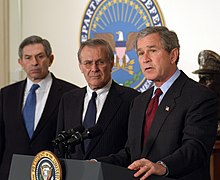
A political view called neoconservatism shifted the terms of the fence in the early 2000s. Neoconservatives differed from their opponents in that they interpreted problems facing the nation as moral issues rather than economic or political problems. For example, neoconservatives saw the decline of the traditional family structure equally a spiritual crisis that required a spiritual response. Critics accused neoconservatives of confusing crusade and consequence.[xx]
During the 2000s, voting for Republicans began to correlate heavily with traditionalist or orthodox religious belief beyond diverse religious sects. Voting for Democrats became more correlated to liberal or modernist religious belief, and to being nonreligious.[21] Belief in scientific conclusions, such as climatic change, also became tightly coupled to political party affiliation in this era, causing climate scholar Andrew Hoffman to observe that climate change had "become enmeshed in the so-chosen culture wars."[22]

Rally for Suggestion 8, an item on the 2008 California election to ban same-sex activity marriage
Topics traditionally associated with culture war were non prominent in media coverage of the 2008 election flavour, with the exception of coverage of vice-presidential candidate Sarah Palin,[23] who drew attending to her conservative religion and created a performative climatic change denialism brand for herself.[24] Palin's defeat in the election and subsequent resignation every bit governor of Alaska caused the Eye for American Progress to predict "the coming end of the culture wars," which they attributed to demographic change, peculiarly high rates of acceptance of same-sexual activity marriage amidst millennials.[25]
2014–present: Broadening of the culture war [edit]
While traditional culture war problems, notably ballgame, continue to be a focal point,[26] the issues identified with culture war broadened and intensified in the mid-late 2010s. Announcer Michael Grunwald says that "President Donald Trump has pioneered a new politics of perpetual culture war" and lists the Blackness Lives Affair motion, U.S. national anthem protests, climate alter, education policy, healthcare policy including Obamacare, and infrastructure policy as culture war bug in 2018.[27] The rights of transgender people and the role of religion in lawmaking were identified equally "new fronts in the culture war" by political scientist Jeremiah Castle, equally the polarization of public opinion on these 2 topics resemble that of previous civilization state of war issues.[28] In 2020, during the COVID-19 pandemic, North Dakota governor Doug Burgum described opposition to wearing confront masks as a "senseless" culture war issue that jeopardizes human safety.[29]
This broader understanding of civilization state of war bug in the mid-late 2010s and 2020s is associated with a political strategy called "owning the libs." Bourgeois media figures employing this strategy, prominently Ben Shapiro, emphasize and aggrandize upon civilization state of war problems with the goal of upsetting liberal people. According to Nicole Hemmer of Columbia University, this strategy is a substitute for the cohesive conservative ideology that existed during the Cold War. Information technology holds a conservative voting bloc together in the absence of shared policy preferences amongst the bloc's members.[xxx]

A number of conflicts about multifariousness in pop culture occurring in the 2010s, such as the Gamergate harassment entrada, Comicsgate and the Sad Puppies science fiction voting campaign, were identified in the media as beingness examples of the culture war.[32] Journalist Caitlin Dewey described Gamergate as a "proxy war" for a larger civilisation war betwixt those who want greater inclusion of women and minorities in cultural institutions versus anti-feminists and traditionalists who practice not.[33] The perception that culture state of war conflict had been demoted from electoral politics to popular culture led writer Jack Meserve to call popular movies, games, and writing the "last forepart in the culture war" in 2015.[34]
These conflicts about representation in popular civilisation re-emerged into balloter politics via the alt-right and alt-light movements.[35] Co-ordinate to media scholar Whitney Phillips, Gamergate "prototyped" strategies of harassment and controversy-stoking that proved useful in political strategy. For instance, Republican political strategist Steve Bannon publicized pop-culture conflicts during the 2016 presidential entrada of Donald Trump, encouraging a young audition to "come in through Gamergate or whatever and then get turned onto politics and Trump."[36]
Criticism and evaluation [edit]
Since the fourth dimension that James Davison Hunter get-go applied the concept of culture wars to American life, the idea has been subject area to questions about whether "culture wars" names a real phenomenon, and if and so, whether the phenomenon it describes is a cause of, or just a result of, membership in groups similar political parties and religions. Civilisation wars accept also been subject to the criticism of existence bogus, imposed, or asymmetric conflicts, rather than a upshot of authentic differences between cultures.
Validity [edit]
Researchers have differed about the scientific validity of the notion of civilisation war. Some claim it does not depict real behavior, or that it describes only the behavior of a pocket-sized political aristocracy. Others claim culture war is real and widespread, and fifty-fifty that it is fundamental to explaining Americans' political behavior and behavior.
Political scientist Alan Wolfe participated in a series of scholarly debates in the 1990s and 2000s confronting Hunter, claiming that Hunter's concept of culture wars did not accurately describe the opinions or behavior of Americans, which Wolfe claimed were more united than polarized.[37]
A meta-analysis of opinion data from 1992 to 2012 published in the American Political Science Review concluded that, in contrast to a common belief that political party and religious membership shape opinion on culture war topics, instead opinions on civilisation state of war topics atomic number 82 people to revise their party and religious orientations. The researchers view culture war attitudes as "foundational elements in the political and religious belief systems of ordinary citizens."[38]
Artificiality or asymmetry [edit]
Some writers and scholars have said that culture wars are created or perpetuated by political special interest groups, by reactionary social movements, by dynamics inside the Republican political party, or by balloter politics equally a whole. These authors view civilization war non as an unavoidable event of widespread cultural differences, simply as a technique used to create in-groups and out-groups for a political purpose.
Political commentator E. J. Dionne has written that culture war is an balloter technique to exploit differences and grievances, remarking that the real cultural segmentation is "between those who desire to have a culture state of war and those who don't."[21]
Sociologist Scott Melzer says that culture wars are created by conservative, reactive organizations and movements. Members of these movements possess a "sense of victimization at the hands of a liberal culture run amok. In their eyes, immigrants, gays, women, the poor, and other groups are (undeservedly) granted special rights and privileges." Melzer writes virtually the example of the National Rifle Clan, which he says intentionally created a culture state of war in order to unite conservative groups, peculiarly groups of white men, against a common perceived threat.[39]
Similarly, religion scholar Susan B. Ridgely has written that culture wars were made possible by Focus on the Family. This organisation produced bourgeois Christian "alternative news" that began to bifurcate American media consumption, promoting a particular "traditional family" archetype to ane part of the population, especially conservative religious women. Ridgely says that this tradition was depicted as under liberal attack, seeming to necessitate a culture war to defend the tradition.[40]
Political scientists Matt Grossmann and David A. Hopkins accept written nearly an disproportion between the The states's two major political parties, maxim the Republican party should be understood equally an ideological motion built to wage political disharmonize, and the Autonomous party as a coalition of social groups with less power to impose ideological discipline on members.[41] This encourages Republicans to perpetuate and to draw new problems into culture wars, considering Republicans are well equipped to fight such wars.[42]
Canada [edit]
Some observers in Canada have used the term "culture state of war" to refer to differing values between Western versus Eastern Canada, urban versus rural Canada, equally well as conservatism versus liberalism and progressivism.[43]
Nevertheless, Canadian gild is generally not dramatically polarized over immigration, gun control, drug legality, sexual morality, or government interest in healthcare: the main issues at play in the United States. In all of those cases, the majority of Canadians, including Conservatives would support the "progressive" position in the United States. In Canada a different fix of bug create a clash of values. Chief among these are linguistic communication policy in Canada, minority religious rights, pipeline politics, indigenous land rights, climate policy, and federal-provincial disputes.
Information technology is a relatively new phrase in Canadian political commentary. It tin can notwithstanding exist used to draw historical events in Canada, such as the Rebellions of 1837, Western Breach, the Quebec sovereignty movement, and whatsoever Ancient conflicts in Canada; only is more relevant to current events such as the Grand River state dispute and the increasing hostility between bourgeois and liberal Canadians.[ commendation needed ] The phrase has too been used to depict the Harper regime'due south attitude towards the arts customs. Andrew Coyne termed this negative policy towards the arts customs as "class warfare."[44]
Australia [edit]
During the tenure of the Liberal–National Coalition government of 1996 to 2007, interpretations of Aboriginal history became a part of a wider political debate regarding Australian national pride and symbolism occasionally called the "culture wars", more than often the "history wars".[45] This argue extended into a controversy over the presentation of history in the National Museum of Australia and in high-school history curricula.[46] [47] It also migrated into the general Australian media, with major broadsheets such as The Australian, The Sydney Morning Herald and The Age regularly publishing opinion pieces on the topic. Marcia Langton has referred to much of this wider debate every bit "war porn"[48] and as an "intellectual expressionless end".[49]
2 Australian Prime number Ministers, Paul Keating (in office 1991–1996) and John Howard (in role 1996–2007), became major participants in the "wars". Co-ordinate to Marking McKenna'south analysis for the Australian Parliamentary Library,[50] John Howard believed that Paul Keating portrayed Australia pre-Whitlam (Prime Minister from 1972 to 1975) in an unduly negative lite; while Keating sought to altitude the mod Labor movement from its historical support for the monarchy and for the White Australia policy by arguing that it was the bourgeois Australian parties which had been barriers to national progress. He accused Britain of having abandoned Commonwealth of australia during the 2nd World State of war. Keating staunchly supported a symbolic apology to Australian Aboriginals for their mistreatment at the hands of previous administrations, and outlined his view of the origins and potential solutions to contemporary Ancient disadvantage in his Redfern Park Speech of 10 December 1992 (drafted with the help of historian Don Watson). In 1999, following the release of the 1998 Bringing Them Home Report, Howard passed a Parliamentary Motion of Reconciliation describing handling of Aborigines as the "most blemished chapter" in Australian history, but he refused to issue an official amends.[51] Howard saw an apology as inappropriate equally it would imply "intergeneration guilt"; he said that "practical" measures were a better response to gimmicky Aboriginal disadvantage. Keating has argued for the eradication of remaining symbols linked to colonial origins: including deference for ANZAC Mean solar day,[52] for the Australian flag and for the monarchy in Australia, while Howard supported these institutions. Unlike beau Labor leaders and contemporaries, Bob Hawke (Prime Minister 1983–1991) and Kim Beazley (Labor Political party leader 2005–2006), Keating never traveled to Gallipoli for ANZAC Day ceremonies. In 2008 he described those who gathered in that location every bit "misguided".[53]
In 2006 John Howard said in a speech to marking the 50th anniversary of Quadrant that "Political Correctness" was dead in Commonwealth of australia but: "nosotros should not underestimate the degree to which the soft-left still holds sway, even dominance, peculiarly in Australia'southward universities".[ commendation needed ] Besides in 2006, Sydney Forenoon Herald political editor Peter Hartcher reported that Opposition strange-affairs spokesman Kevin Rudd was inbound the philosophical debate past arguing in response that "John Howard, is guilty of perpetrating 'a fraud' in his then-chosen civilisation wars ... designed non to make real change merely to mask the damage inflicted by the Authorities's economic policies".[54]
The defeat of the Howard government in the Australian Federal ballot of 2007 and its replacement past the Rudd Labor regime altered the dynamic of the debate. Rudd made an official apology to the Aboriginal Stolen Generation [55] with bi-partisan support.[56] Similar Keating, Rudd supported an Australian republic, but in contrast to Keating, Rudd alleged support for the Australian flag and supported the celebration of ANZAC Mean solar day; he also expressed admiration for Liberal Party founder Robert Menzies.[57] [58]
Subsequent to the 2007 change of authorities, and prior to the passage, with back up from all parties, of the Parliamentary apology to indigenous Australians, Professor of Australian Studies Richard Nile argued: "the culture and history wars are over and with them should also go the adversarial nature of intellectual debate",[59] a view contested by others, including bourgeois commentator Janet Albrechtsen.[60]
Africa [edit]
According to political scientist Constance G. Anthony, American civilization state of war perspectives on human sexuality were exported to Africa equally a form of neocolonialism. In his view, this began during the AIDS epidemic in Africa, with the Usa government commencement tying HIV/AIDS assistance money to evangelical leadership and the Christian right during the Bush-league assistants, then to LGBTQ tolerance during the administration of Barack Obama. This stoked a culture state of war that resulted in (amongst others) the Uganda Anti-Homosexuality Act of 2014.[61]
Zambian scholar Kapya Kaoma notes that considering "the demographic eye of Christianity is shifting from the global North to the global South" Africa's influence on Christianity worldwide is increasing. American conservatives export their culture wars to Africa, Kaoma says, particularly when they realize they may be losing the battle back home. Us Christians have framed their anti-LGBT initiatives in Africa as continuing in opposition to a "Western gay agenda", a framing which Kaoma finds ironic.[62]
N American and European conspiracy theories have become widespread in West Africa via social media, according to 2021 survey by Offset Typhoon News. COVID-xix misinformation, New World Order conspiracy thinking, Qanon and other conspiracy theories associated with culture state of war topics are spread past American, Pro-Russian, French-linguistic communication, and local disinformation websites and social media accounts, including prominent politicians in Nigeria. This has contributed to vaccine hesitancy in Westward Africa, with 60 percentage of survey respondents saying they were unlikely to try to get vaccinated, and an erosion of trust in institutions in the region.[63]
Mainland china [edit]
The aim of the Cultural Revolution was to attack the Four Olds-- Old Ideas, Old Civilisation, Old Habits, and One-time Customs. The motility led to the removal of backer and traditional Chinese symbolism following the Chinese Communist Revolution.[64] [65]
United Kingdom [edit]
A 2021 written report by the policy plant of King'southward Higher London argued that many people's views on cultural issues in United kingdom of great britain and northern ireland have become tied up with the side of the Brexit argue with which they identify, while the public party-political identities, although not equally strong, show similar alignments and that around half the country held relatively potent views on "culture war" problems such equally debates on United kingdom's colonial history or Black Lives Matter. However, the report concluded Britain's cultural and political split up was not as stark equally the Republican-Democratic split in the United states and that a sizeable section of the public can be categorised equally having either moderate views or as being disengaged from social debates. The Conservative Political party have been described as attempting to ignite culture wars in regard to "conservative values" under the tenure of Prime Government minister Boris Johnson.[66] [67] [68] [69] Other observers, such as Johns Hopkins Academy professor and political scientist Yascha Mounk and journalist Louise Perry have argued that a plummet in back up for the Labour Party during the 2019 United Kingdom general election came as a result of both a public perception and a deliberate strategy of Labour of pursuing messages and policy ideas based on cultural bug that resonated with grassroots activists on the left of the political party but alienated Labour'south traditional working class voters.[70] [71]
Europe [edit]
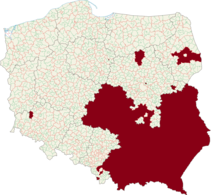
Several media outlets accept described the Law and Justice party in Poland,[73] Viktor Orbán in Hungary, Aleksandar Vučić in Serbia, and Janez Janša in Slovenia as igniting culture wars in their respective countries by encouraging fights over LGBT rights, legal abortion, and other topics.[74] According to The National Involvement, there is a cultural war in Ukraine.[75]
After 2017, Poland's Law and Justice (PiS) authorities destroyed nearly of the Soviet War Memorials in Poland.[76] [77]
In early on 2018, both chambers of the Shine parliament (the Sejm and Senate) adopted an Amendment to the Act on the Institute of National Remembrance, criminalizing the ascription to Poles collectively of complicity in Earth War Two Jewish-Holocaust-related or other war crimes committed by the Axis powers, and condemning use of the expression, "Polish death campsite".[78] [79] [80] The law sparked a crisis in Israel–Poland relations .[81] The Amendment's passage worsened Poland–Ukraine relations, already contentious on the questions of the prewar Organization of Ukrainian Nationalists and the wartime and postwar Ukrainian Insurgent Army, whose leaders Stepan Bandera and Roman Shukhevych have been considered Ukrainian national heroes in Ukraine, and war criminals in Poland.[82] [83] Historical bug regarding the Ukrainian Insurgent Army and their massacres of Poles in Volhynia and Eastern Galicia remain a contested topic. Ukrainian retentiveness laws (the Ukrainian decommunization laws) passed in 2015, honoring UPA, related organizations and its members, were criticized in Poland.[84]
In June 2020, the Polish President Andrzej Duda said that he would not allow gay couples to marry or prefer children, while describing the LGBT movement as "a foreign ideology" and comparison it to the communist indoctrination in Shine schools during the PRL flow.[85] [86]
Come across also [edit]
References [edit]
- ^ "Culture war". Dictionary.com . Retrieved October 21, 2019.
- ^ a b "Culture Wars". Encyclopedia.com . Retrieved October 21, 2019.
- ^ Spahn, Martin (1910). "Kulturkampf". The Catholic Encyclopedia. Vol. 8. New York: Robert Appleton Company. Retrieved March 27, 2015.
- ^ "Prosecution of priests (Culture War reference) (1874)". Newspapers.com . Retrieved March 13, 2019.
- ^ "Seminar on the Civilization Wars of the 1920s". Fall 2001. Retrieved October 24, 2021.
- ^ Dionne, E. J. "Culture Wars: How 2004".
- ^ "What Bismarck could not exercise (Civilization War reference) (1906)". Newspapers.com . Retrieved March xiii, 2019.
- ^ "'Culture War' to exist theme of talk (1942)". Newspapers.com . Retrieved March 13, 2019.
- ^ Brian Dakss, "Bill O'Reilly'south 'Culture Warrior'", CBS News, Dec 5, 2006. Retrieved March 27, 2020.
- ^ O'Reilly, Bill (September 2006). Civilization Warrior. New York: Broadway Books. ISBN0-7679-2092-9.
- ^ Illing, Sean (July ix, 2020). "Is evangelical support for Trump a contradiction?". Vox . Retrieved July ix, 2020.
- ^ "Dogs of War". New Donkey. September 2, 2004. Archived from the original on March viii, 2005. Retrieved Baronial 29, 2006.
Not since Pat Buchanan's famous 'culture war' speech in 1992 has a major speaker at a national political convention spoken so hatefully, at such length, well-nigh the opposition.
- ^ a b Buchanan, Patrick (Baronial 17, 1992). 1992 Republican National Convention Speech (Speech communication). Retrieved Nov iii, 2014.
- ^ Buchanan, Patrick. "The Cultural War for the Soul of America".
- ^ Andrew Hartman, A State of war for the Soul of America: A History of the Civilisation Wars (University of Chicago Printing, 2015)
- ^ Chapman, Roger (2010). Civilisation Wars: An Encyclopedia of Bug, Viewpoints, and Voices. Armonk, NY: M. East. Sharpe. p. 88. ISBN978-0-7656-1761-3.
- ^ Chapman, Roger (2010). Civilization Wars: An Encyclopedia of Issues, Viewpoints, and Voices. Armonk, NY.: K. E. Sharpe. p. 136. ISBN978-0-7656-1761-three.
- ^ Who Owns History: Rethinking the Past in a Changing World at Google Books
- ^ History on Trial: Culture Wars and the Teaching of the By at Google Books
- ^ Zafirovski, Milan. "Modern Free Club and Its Nemesis: Freedom Versus Conservatism in the New Millennium " Google Books. 6 September 2018.
- ^ a b Dionne, E.J., Jr. "Why the Culture War Is the Wrong State of war." The Atlantic. January/February 2006. 29 April 2019.
- ^ a b Climate Science as Civilization State of war: The public debate around climate change is no longer virtually science—it's most values, culture, and ideology Fall 2012 Stanford Social Innovation Review
- ^ "How the News Media Covered Religion in the 2008 General Election: Sarah Palin and the "Civilisation Wars"" (PDF). Journalism & Media: eight, 11–12. November 20, 2008. Retrieved May 23, 2020.
- ^ Hatzisavvidou, Sophia (September 17, 2019). "'The climate has always been irresolute': Sarah Palin, climate change denialism, and American conservatism". Celebrity Studies. 12 (3): 371–388. doi:10.1080/19392397.2019.1667251. S2CID 204377874.
- ^ Teixeira, Ruy (July 15, 2009). "The Coming End of the Culture Wars". Middle for American Progress . Retrieved May 23, 2020.
- ^ Smith, Karl. "The Abortion Debate Is Not Part of the Culture Wars." Bloomberg.
- ^ Grunwald, Michael (November 2018). "How Everything Became the Civilisation State of war". Political leader . Retrieved May 24, 2020.
- ^ Castle, Jeremiah (December 14, 2018). "New Fronts in the Culture Wars? Religion, Partisanship, and Polarization on Religious Liberty and Transgender Rights in the United States". American Politics Inquiry. 47 (3): 650–679. doi:10.1177/1532673X18818169. S2CID 220207260.
- ^ Blake, Aaron (May 23, 2020). "GOP governor offers emotional plea to the anti-mask crowd: Stop this senseless culture war". The Washington Mail . Retrieved May 24, 2020.
- ^ Peters, Jeremy W. (August 3, 2020). "These Conservatives Accept a Laser Focus: 'Owning the Libs'". New York Times.
- ^ Buffington, Melanie L. (January ane, 2017). "Contemporary Civilization Wars: Challenging the Legacy of the Confederacy". Journal of Cultural Inquiry in Fine art Instruction. 34: 45–59. ISSN 2152-7172. Retrieved May 24, 2020.
- ^ Hurley, Kameron (April 9, 2015). "Hijacking the Hugo Awards Won't Stifle Diversity in Science Fiction". The Atlantic . Retrieved May 23, 2020.
- ^ Dewey, Caitlin (October 14, 2014). "The only guide to Gamergate you lot will ever need to read". The Washington Post . Retrieved May 23, 2020.
- ^ Meserve, Jack (Spring 2015). "Last Front end in the Civilization War". Republic: A Journal of Ideas (36). Retrieved May 23, 2020.
- ^ Nagle, Angela (June 30, 2017). Impale All Normies: Online Culture Wars From 4Chan And Tumblr To Trump And The Alt-Correct. Zero Books. ISBN9781785355431.
- ^ Warzel, Charlie (August xv, 2019). "How an Online Mob Created a Playbook for a Civilisation War". The New York Times . Retrieved May 24, 2020.
- ^ Hunter, James Davison; Wolfe, Alan (2006). Is There a Civilization War? : A Dialogue on Values and American Public Life. Washington, D.C.: Brookings Establishment Press. OCLC 76966750.
- ^ Goren, Paul; Chapp, Christopher (February 24, 2017). "Moral Power: How Public Opinion on Civilisation War Issues Shapes Partisan Predispositions and Religious Orientations". American Political Science Review. 111 (one): 110–128. doi:ten.1017/S0003055416000435. S2CID 151573922.
- ^ Melzer, Scott (October i, 2009). Gun Crusaders: The NRA'due south Culture War. New York University Printing. p. 59. ISBN978-0814764503.
- ^ Ridgely, Susan B. (March 2020). "Conservative Christianity and the Creation of Culling News: An Assay of Focus on the Family unit'southward Multimedia Empire". Religion and American Culture. xxx (1): one–25. doi:10.1017/rac.2020.one.
- ^ Grossmann, Matt; Hopkins, David A. (March 2015). "Ideological Republicans and Group Interest Democrats: The Disproportion of American Party Politics". Perspectives on Politics. 13 (1): 119–139. doi:10.1017/S1537592714003168. S2CID 144639776.
- ^ Hopkins, David A. (April 15, 2020). "Solving the COVID Crisis Requires Bipartisanship, Simply the Modern GOP Isn't Built for Information technology". Honest Graft . Retrieved May 24, 2020.
- ^ Caplan, Gerald (October 20, 2012). "Culture clash splits Canadians over basic values". The World and Mail service. Toronto.
- ^ Andrew Coyne (Oct two, 2008). "Coyne: This isn't a culture war, it's a skilful old class war". Macleans.
- ^ Manne, Robert (November 2008). "What is Rudd'due south Agenda?". The Monthly.
- ^ Rundle, Guy (June 28, 2007). "1915 and all that: History in a holding pattern". Crikey . Retrieved April 27, 2010.
- ^ Ferrari, Justine (October 14, 2008). "History curriculum author defies his critics to find bias". The Australian. Archived from the original on Oct 6, 2009. Retrieved April 27, 2010.
- ^ Baudrillard J. War porn. Journal of Visual Culture, Vol. 5, No. i, 86–88 (2006) doi: ten.1177/147041290600500107
- ^ Langton M. Essay: "Trapped in the ancient reality prove". Griffith Review 2007, xix:Re-imagining Australia.
- ^ Mark McKenna (November 10, 1997). "Dissimilar Perspectives on Black Armband History". Parliamentary Library: Research Paper 5 1997-98. The Parliament of Australia. Retrieved March 5, 2015.
- ^ "The History of Apologies Downwards Under | Thinking Religion". thinkingfaith.org. Feb 21, 2008. Archived from the original on December ii, 2014. Retrieved March five, 2015.
- ^ Wright, Tony (October 30, 2008). "A nation reborn at Anzac Cove? Utter nonsense: Keating". The Sydney Forenoon Herald.
- ^ Wright, Tony (October 31, 2008). "A nation reborn at Anzac Cove? Utter nonsense: Keating". The Historic period. Melbourne. Retrieved March five, 2010.
- ^ "PM's civilisation wars a fraud: Rudd - National". The Sydney Morning Herald. October 28, 2006. Retrieved April 27, 2010.
- ^ "Full text of Australia's apology to Aborigines". CNN. Feb 12, 2008. Retrieved Apr 27, 2010.
- ^ "Brendan Nelson's sorry speech". The Sydney Forenoon Herald. February 13, 2008. Retrieved April 27, 2010.
- ^ "Paul Keating 'utterly wrong' to reject Gallipoli identity, says Kevin Rudd". October 31, 2008.
- ^ "Is Rudd having a Bob each manner? - Stance". The Sydney Morning Herald. October 28, 2004. Retrieved April 27, 2010.
- ^ "End of the culture wars | Richard Nile Web log, The Australian". blogs.theaustralian.news.com.au. November 28, 2007. Archived from the original on March 9, 2010. Retrieved Apr 27, 2010.
- ^ "Orwellian Left quick to unveil totalitarian centre". The Australian. December 12, 2007.
- ^ Anthony, Constance Chiliad. (November 2018). "Schizophrenic Neocolonialism: Exporting the American Civilisation War on Sexuality to Africa". International Studies Perspectives. nineteen (4): 289–304. doi:10.1093/internet service provider/eky004.
- ^ van Klinken, Adriaan (2017). "Culture Wars, Race, and Sexuality: A Nascent Pan-African LGBT-Affirming Christian Movement and the Future of Christianity". Journal of Africana Religions. 5 (2): 217–238. doi:x.5325/jafrireli.5.2.0217. JSTOR 10.5325/jafrireli.5.2.0217. Archived from the original on October 11, 2016. Retrieved May 4, 2021.
- ^ Dotto, Carlotta; Cubbon, Seb (June 23, 2021). Disinformation exports: How foreign anti-vaccine narratives reached West African communities online (Report). First Draft News. Retrieved June 23, 2021.
- ^ "Temples, opera, and braids: Photos reveal what Prc looked like earlier the Cultural Revolution". Business Insider. March iv, 2020.
- ^ "Why Us and China are both stalked by concerns about the Cultural Revolution". Southward China Morning Post. July 11, 2020.
- ^ Balls, Katy (September 29, 2020). "The Tories are spoiling for a culture war to stand up for 'British values'". inews.co.uk . Retrieved February 8, 2021.
- ^ Malik, Kenan (Dec twenty, 2020). "The Tory 'class agenda' is a civilization war stunt that will leave inequality untouched". The Guardian . Retrieved February 8, 2021.
- ^ Stonemason, Paul (Feb ten, 2021). "Boris Johnson's probe into left-wing "extremism" is a unsafe distraction from the fascist threat". New Statesman . Retrieved February 18, 2021.
This is, at one level, part of the pre-scripted culture state of war being orchestrated by those around [Boris] Johnson.
- ^ "UK culture war: museum trustees are paying the cost for disagreeing with authorities'south policies". www.theartnewspaper.com. June 7, 2021.
- ^ "How Labour Lost the Civilization War". The Atlantic. December thirteen, 2019.
- ^ "The Britain is immersed in a course-culture war – and Labour is incapable of winning it". June 22, 2021.
- ^ "Polish president revives attacks on LGBT community in re-election entrada". The Irish Times. June 12, 2020.
- ^ Rohac, Dalibor; Kokonos, Lance (November two, 2020). "Poland's Civilisation Wars". Foreign Policy . Retrieved November 4, 2020.
- ^ Kakissis, Joanna (Nov iv, 2020). "Slovenian Prime Government minister Thanks Trump 'Triumph' Despite Untallied Votes". NPR. Athens, Greece. Retrieved November 4, 2020.
- ^ "Ukraine's Culture War". The National Interest. February seven, 2014.
- ^ "Poland plans to tear downwardly hundreds of Soviet memorials". Deutsche Welle. April 13, 2016.
- ^ "And then And Now: Soviet Monuments Disappear Across Poland". Radio Free Europe/Radio Liberty. October 23, 2020.
- ^ Eglash, Ruth; Selk, Avi (January 28, 2018). "Israel and Poland try to tamp down tensions after Poland'south 'death camp' police force sparks Israeli outrage". The Washington Post.
- ^ Heller, Jeffrey; Goettig, Marcin (Jan 28, 2018). "Israel and Poland clash over proposed Holocaust law". Reuters.
- ^ Katz, Brigit (January 29, 2018). "The Controversy Around Poland'south Proposed Ban on the Term "Smooth Death Camps"". The Smithsonian Magazine.
- ^ "The Latest: Party head: Israel confirms Smoothen view on Nazis". ABC News . Retrieved July 7, 2018.
- ^ Baran, Violetta, ed. (February 6, 2018). "Były minister obrony Ukrainy ostrzega: ponad milion Ukraińców może chwycić za kopie" [Former Ukrainian Minister of Defense Warns: over a million Ukrainians may take up the cudgels]. WP Wiadomości (in Shine). Wirtualna Polska. Retrieved May 16, 2019.
- ^ Kozińska, Anna, ed. (Feb 1, 2018). "Spór na linii Polska-Izrael. Do grona komentatorów dołączyła Ukraina". WP Wiadomości (in Polish). Wirtualna Polska.
- ^ ""Mówię: UPA odpowiada za ludobójstwo Polaków. Ukraińcy, ścigajcie mnie!"" (in Polish). Retrieved March 6, 2018.
- ^ "Smooth President Calls 'LGBT Ideology' More Harmful Than Communism". Time . Retrieved June 14, 2020.
- ^ "Smooth ballot: Andrzej Duda says LGBT 'credo' worse than communism". BBC News. June 14, 2020.
Further reading [edit]
- Chapman, Roger, and James Ciment. Culture Wars: An Encyclopedia of Issues, Viewpoints and Voices (2nd ed. Routledge, 2015)
- D'Antonio, William V., Steven A. Tuch and Josiah R. Baker, Organized religion, Politics, and Polarization: How Religiopolitical Conflict Is Changing Congress and American Democracy (Rowman & Littlefield, 2013) ISBN 1442223979 ISBN 978-1442223974
- Fiorina, Morris P., with Samuel J. Abrams and Jeremy C. Pope, Civilization State of war?: The Myth of a Polarized America (Longman, 2004) ISBN 0-321-27640-X
- Graff, Gerald. Beyond the Culture Wars: How Teaching the Conflicts Can Revitalize American Teaching (1992)
- Hartman, Andrew. A war for the soul of America: a history of the civilization wars (University of Chicago Press, 2015)
- Hunter, James Davison, Civilisation Wars: The Struggle to Define America (New York: Basic Books, 1992) ISBN 0-465-01534-four
- Jay, Gregory S., American Literature and the Civilisation Wars, (Cornell University Press, 1997) ISBN 0-8014-3393-2 ISBN 978-0801433931
- Jensen, Richard. "The Culture Wars, 1965-1995: A Historian's Map" Journal of Social History 29 (October 1995) 17–37. in JSTOR
- Jones, East. Michael, Degenerate Moderns: Modernity As Rationalized Sexual Misbehavior, Ft. Collins, CO: Ignatius Printing, 1993 ISBN 0-89870-447-2
- Prothero, Stephen (2017). Why Liberals Win the Culture Wars (Fifty-fifty When They Lose Elections): A History of the Religious Battles That Define America from Jefferson'southward Heresies to Gay Marriage Today. HarperOne. ISBN978-0061571312.
- Strauss, William & Howe, Neil, The Fourth Turning, An American Prophecy: What the Cycles of History Tell Us Near America's Next Rendezvous With Destiny, 1998, Broadway Books, New York
- Thomson, Irene Tavis., Culture Wars and Indelible American Dilemmas, (University of Michigan Press, 2010) ISBN 978-0-472-07088-six
- Walsh, Andrew D., Faith, Economics, and Public Policy: Ironies, Tragedies, and Absurdities of the Contemporary Civilization Wars, (Praeger, 2000) ISBN 0-275-96611-9
- Webb, Adam G., Beyond the Global Culture War, (Routledge, 2006) ISBN 0-415-95313-eight
- Zimmerman, Jonathan, Whose America? Culture Wars in the Public Schools (Harvard University Press, 2002) ISBN 0-674-01860-5
External links [edit]
 | Expect upward civilisation war in Wiktionary, the gratis dictionary. |
Source: https://en.wikipedia.org/wiki/Culture_war
0 Response to "what main issues gave rise to the culture wars of the 1990s"
Postar um comentário